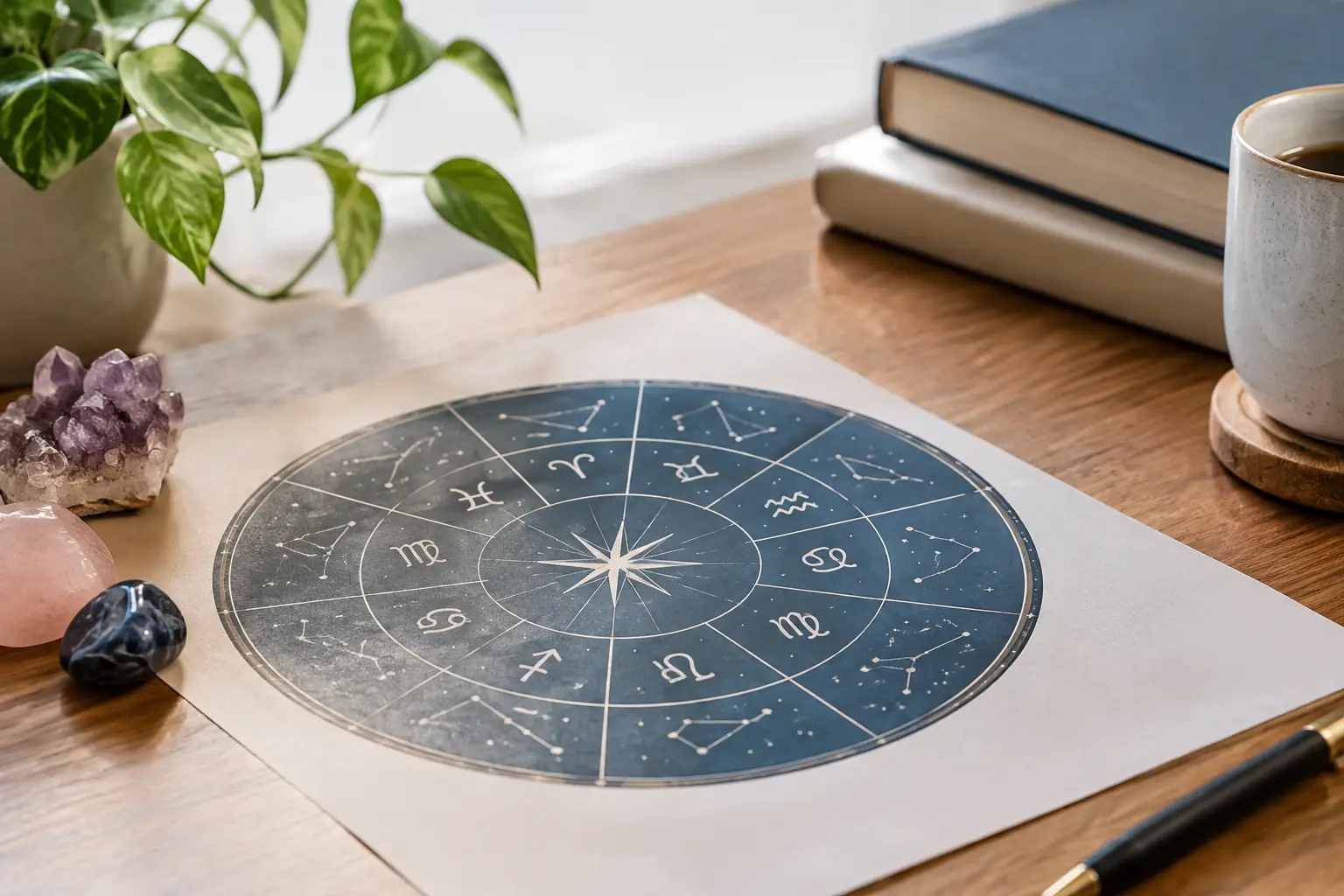
A birth chart can look crowded and intimidating at first: symbols, lines, numbers, and a circle divided into twelve sections. But astrology houses explained simply are the twelve areas of life where your story unfolds. They do not tell you what you must do. They show where certain patterns, questions, gifts, and growing pains may be most active.
If you have ever wondered why a reading focuses on relationships, work, family, or a sudden change in confidence, the houses help provide the context. A planet describes an energy, a zodiac sign describes how that energy tends to express itself, and a house shows where you are likely to experience it.
What Astrology Houses Actually Represent
Think of your birth chart as a map drawn for the exact time and place you were born. The houses are its twelve rooms. Each room relates to a meaningful part of ordinary human life, from the way you present yourself to the way you process loss, build a career, love, rest, and make sense of your beliefs.
The first house begins with the Ascendant, also called the rising sign. That is why an accurate birth time matters so much. A difference of even a few minutes can sometimes shift the house placements, especially when a planet sits near a house boundary. If you do not know your exact time, an astrology reading can still offer insight, but it should be interpreted with more care rather than treated as fixed fact.
There is also more than one way to calculate houses. Whole Sign, Placidus, and Equal House are common systems. One is not automatically more truthful than another. Different systems may place a planet in a different house, highlighting another layer of the same person. A thoughtful reading looks for the themes that genuinely fit your lived experience, not a dramatic claim that leaves no room for nuance.
Astrology Houses Explained: The 12 Life Areas
First through Third Houses: Self, Resources, and Mind
The first house is your approach to life, first impressions, physical presence, and sense of identity. It is not your whole personality, but it often describes the energy people notice when they meet you and the instinctive way you move through new situations.
The second house speaks to money, possessions, skills, values, and self-worth. It is not simply a promise of wealth. It can reveal your relationship with security, what you need to feel stable, and where you may need to value your own abilities more honestly.
The third house concerns communication, learning, siblings, neighbors, short trips, and the everyday exchange of information. Strong third-house themes can show up in writing, teaching, speaking up, asking better questions, or learning to say what you mean without abandoning your feelings.
Fourth through Sixth Houses: Home, Joy, and Daily Life
The fourth house is the private foundation beneath your public life. It relates to home, family roots, ancestry, emotional safety, and the environment you need to recover and feel like yourself. It can describe childhood patterns, but it does not trap you inside them. It also speaks to the home you are creating now.
The fifth house brings in creativity, romance, pleasure, self-expression, hobbies, and children. This is where you see what lights you up. It can be especially meaningful when someone feels they have spent years meeting everyone else’s needs and is ready to reconnect with joy.
The sixth house covers routines, work habits, practical responsibilities, service, and well-being. It is often misunderstood as a house of health predictions. A responsible reading does not diagnose illness. Instead, this house can help you notice patterns around stress, boundaries, rest, organization, and the daily choices that support a more sustainable life.
Seventh through Ninth Houses: Partnership, Change, and Meaning
The seventh house centers on committed one-to-one relationships. That includes romantic partners, close business partnerships, contracts, and sometimes open conflict. It can show what you seek in partnership and the patterns you may repeat until you become more conscious of them. It cannot tell you that you are destined to stay with someone who is not treating you well.
The eighth house is often given an unnecessarily frightening reputation. It relates to shared finances, intimacy, trust, grief, endings, inheritance, and deep emotional transformation. This is the house of what asks you to be honest. When it is active, you may be facing a release, a complicated attachment, or the need to rebuild trust after a loss.
The ninth house looks outward toward travel, higher education, spirituality, philosophy, publishing, and your broader worldview. It asks what gives your life meaning beyond the immediate moment. Sometimes its message is literal, such as studying or traveling. Just as often, it points to a change in perspective that makes a different future possible.
Tenth through Twelfth Houses: Purpose, Community, and Inner Life
The tenth house relates to career, public reputation, responsibility, long-term goals, and the direction you feel called to take. It is not only about job titles or fame. For many people, it describes the contribution they want to make and the kind of authority they are learning to claim.
The eleventh house concerns friendships, communities, networks, hopes, and future plans. It can reveal how you function in groups and what kinds of people help you grow. If you are questioning whether you have outgrown a friendship circle, this house can be surprisingly revealing.
The twelfth house is private, subtle, and deeply personal. It speaks to the unconscious, solitude, spiritual reflection, hidden fears, dreams, compassion, and patterns that can be hard to see while you are inside them. It is not a punishment house. At its healthiest, it can point toward healing, forgiveness, creative retreat, and the wisdom that comes from listening inwardly.
How Planets Change the Meaning of a House
A house is the setting, but the planets bring the action. For example, Venus in the seventh house may place extra attention on love, connection, fairness, and partnership. Saturn in the seventh might bring lessons about commitment, standards, timing, or boundaries. Neither placement decides whether a relationship will succeed. They suggest different questions worth asking.
The same applies to career. Jupiter in the tenth house can indicate expansion, visibility, or confidence around professional direction, while Pluto there may describe powerful reinventions and a complicated relationship with control or ambition. Context matters: the sign, aspects to other planets, current transits, and most importantly, your actual choices all shape the story.
This is why a single placement should never be used as a verdict. You are more than your chart, and a good reading should leave you with clearer options rather than fear.
Using the Houses When You Need Clarity
When life feels uncertain, start with the area that is asking for your attention. Relationship questions often involve the fifth, seventh, and eighth houses. Career concerns may bring the second, sixth, and tenth into focus. A move, family tension, or need for emotional grounding can activate the fourth house. There is usually overlap, because real life rarely stays in one neat category.
It can help to bring specific questions to your chart rather than asking for a total life prediction. You might ask: What am I learning about partnership? Where am I underestimating my strengths at work? What needs to change so home feels safer? What pattern am I ready to release?
At Tarot by Lea, astrology is approached as a tool for self-understanding and timing, not a script for your future. Your chart may name a pattern with startling accuracy, yet you remain the person who decides what happens next.
The houses are most useful when they return you to your own life with more compassion and honesty. Notice which room of your chart feels loud right now, then ask yourself what small, grounded choice would honor what you already know.
Comments are closed