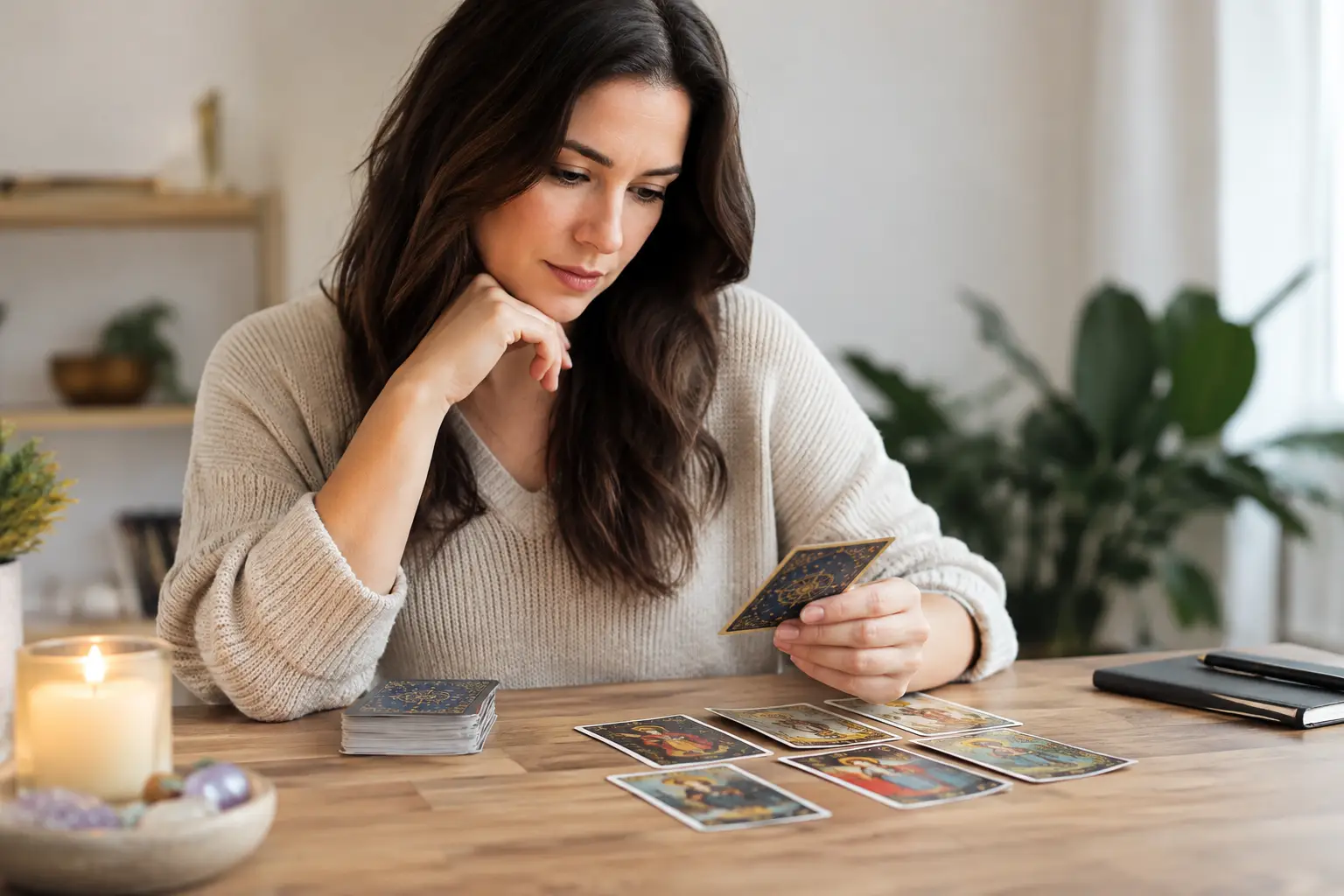
The question is rarely just, “Will we divorce?” More often, it is: “Can I trust what I am feeling?” “Is there anything left to save?” or “How do I make a decision when every option hurts?” Tarot for divorce can offer a calm, private space to look at the emotional truth of a marriage, the patterns surrounding it, and the choices in front of you. It is not about telling you what to do. It is about helping you hear yourself more clearly when fear, grief, anger, and outside opinions are all speaking at once.
Divorce can affect every part of life at the same time: your home, finances, children, friendships, identity, and hopes for the future. A thoughtful tarot reading does not reduce that complexity to a simple yes or no. It brings perspective to what is happening now and helps you recognize where you still have agency.
What Tarot for Divorce Can Help You See
Tarot is especially useful when you feel stuck in a repeating emotional loop. Perhaps you and your spouse have had the same argument for years. Perhaps a betrayal has changed the relationship, but you do not know whether healing is truly possible. Or perhaps the decision has already been made, and you need strength to move through the separation without losing yourself.
The cards can reflect the energy around the relationship: avoidance, unequal effort, unresolved pain, a need for firmer boundaries, or a genuine opportunity for honest repair. They may also show what you are carrying that does not belong to you, such as guilt for another person’s choices or responsibility for keeping everyone comfortable.
A reading can bring insight to questions such as whether communication is likely to improve, what is preventing closure, how to approach a difficult conversation, or what personal healing needs your attention. Sometimes the clearest message is not about the other person at all. It is about rebuilding your own trust, stability, and voice.
That distinction matters. Tarot can reveal patterns and possibilities, but it cannot make a marriage work without willing participation from both people. Nor should spiritual insight be used to excuse harmful behavior or delay necessary action when your safety is at risk.
What a Divorce Tarot Reading Cannot Do
An honest reading has limits, and those limits protect you. Tarot is not legal advice, financial advice, mental health treatment, or a substitute for emergency support. Questions involving custody, property, court strategy, domestic abuse, or financial agreements should be discussed with qualified professionals who can advise you based on your actual circumstances.
It is also not ethical to use tarot as a way to control another person. You may ask about the dynamics between you and your spouse, but a reading should not promise to make someone return, change, or behave in a certain way. Every person has free will. Your power lies in deciding what you will accept, what you need, and how you want to move forward.
Predictions deserve a balanced approach, too. Timing can shift as people make choices, receive new information, or change their behavior. A reading may show a likely direction, a period of movement, or a delay that needs attention. It should never pressure you into making a major decision because you fear a fixed future.
Asking Better Questions During Divorce
The quality of a tarot reading often begins with the question. When you are hurting, it is natural to ask, “Does my spouse still love me?” Yet a question like that can leave you waiting for someone else to determine your peace.
Try bringing the focus back to what you can understand and choose. You might ask: “What do I need to see clearly about this marriage?” “What pattern keeps us from resolving conflict?” “What would support me emotionally during this separation?” “What do I need to know before I have this conversation?” or “What does a healthier next chapter ask of me?”
Questions about reconciliation can be meaningful when approached with honesty. Instead of seeking a guarantee, ask what conditions would need to change for reconciliation to be healthy, whether both people are capable of meeting those conditions, and what you may be overlooking. Sometimes the answer shows a path toward repair. Sometimes it shows that holding on is costing too much. Direct insight is more valuable than reassurance that fades by tomorrow.
When Reconciliation Is Still on the Table
Not every divorce conversation means the relationship is beyond repair. Some couples are dealing with exhaustion, poor communication, grief, family pressure, or years of emotional distance rather than a complete absence of love. Tarot can help identify whether the relationship has a foundation worth rebuilding.
Still, potential is not the same as commitment. A reading may show love or an emotional bond, while also showing avoidance, dishonesty, resentment, or an unwillingness to do the work. If reconciliation is being considered, look for real-world evidence alongside spiritual guidance. Are apologies followed by changed behavior? Can difficult topics be discussed without intimidation or blame? Are both people willing to seek appropriate support?
If the answer is no, tarot can help you acknowledge that truth without judging yourself for wishing things had turned out differently. Loving someone and choosing distance can both be true.
Using Tarot for Emotional Grounding During Separation
The period after deciding to separate can feel strangely disorienting, even when you know the decision is right. There may be grief for the person, the shared history, the home you imagined, or the version of yourself you were within the marriage. You do not have to rush past that grief to prove you are strong.
A divorce tarot reading can offer a moment to pause and reconnect with your center. It may highlight practical themes such as patience, rest, support, boundaries, and careful planning. It can also validate emotions that have been dismissed for too long. Being seen clearly can be deeply grounding when your life is changing quickly.
It helps to enter a reading with one or two intentions rather than trying to solve every detail at once. You may want clarity before speaking with an attorney, emotional support before telling family members, or a sense of direction after the paperwork is filed. A focused question creates room for a more useful conversation.
Afterward, write down what stayed with you. Notice which messages bring relief, which create resistance, and which point toward a practical next step. Tarot is most helpful when insight is allowed to become gentle action: making a call, setting a boundary, gathering information, resting, or asking for support.
Choosing a Reader You Can Trust
Divorce is a vulnerable subject. You deserve a reader who treats it with care, does not use fear to keep you coming back, and does not claim authority over your life. A good reader will be compassionate without giving false hope, direct without being cruel, and clear that you remain in charge of every decision.
You should never feel pressured to disclose more than you wish to share, pay for extra services because of a frightening prediction, or return repeatedly to receive permission for choices you already know you need to make. The right reading leaves you more grounded, not more dependent.
At Tarot by Lea, the purpose of a private phone reading is to offer honest, individualized insight without scripts or pressure. You can bring the questions you are afraid to ask out loud and receive a caring, straightforward perspective while keeping your free will intact.
Whether your path leads toward repair, separation, or a decision that takes more time, be gentle with yourself. Clarity does not always arrive as one dramatic answer. Sometimes it comes as the quiet realization that you are allowed to choose peace, truth, and a future that feels like your own.
Comments are closed