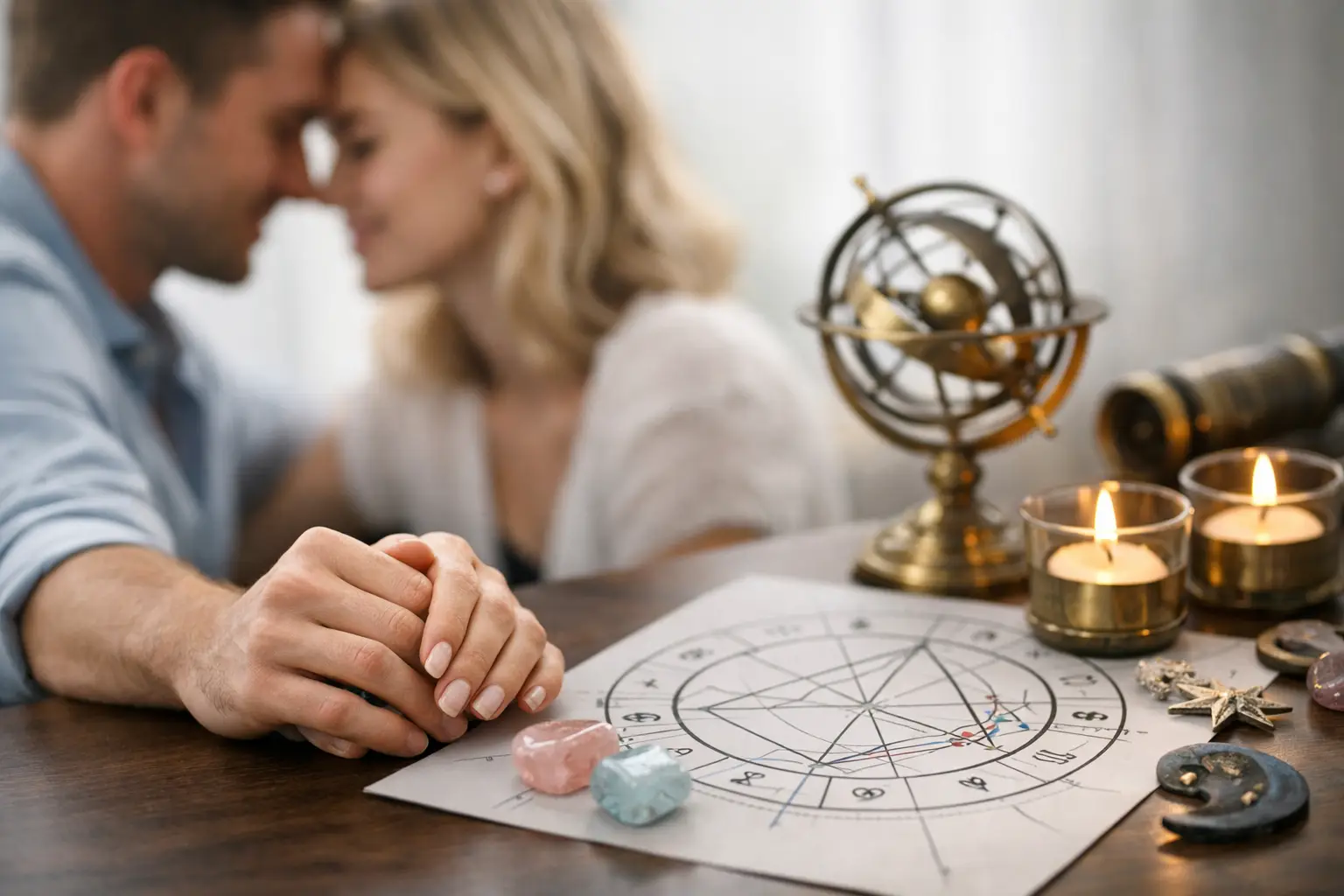
A relationship can feel obvious at first: the pull is strong, the conversation flows, and something about the other person feels familiar. Then the questions arrive. Why do you feel so deeply seen by them, yet struggle to communicate? Why is it hard to let go? A guide to relationship synastry can offer language for these patterns without reducing your love life to a verdict written in the stars.
Synastry is the practice of placing two birth charts together to study how two people affect one another. It can describe chemistry, emotional comfort, recurring pressure points, and the lessons a connection may bring forward. It cannot tell you that you must stay, leave, forgive, or wait. Your choices, boundaries, and lived experience matter more than any chart.
What Relationship Synastry Actually Looks At
Your birth chart is a symbolic picture of the sky at the moment you were born. In synastry, an astrologer compares the planets, signs, houses, and major angles in each person’s chart. The goal is not to label a couple as compatible or incompatible. Most meaningful relationships contain both ease and friction.
The Sun can show how each person expresses identity and purpose. The Moon often speaks to emotional needs, instinctive reactions, and what makes someone feel safe. Venus points toward affection, pleasure, values, and how love is offered. Mars can reveal desire, drive, sexual energy, anger, and the way conflict gets activated.
Mercury matters more than many people expect. It can show whether conversations feel natural, whether one person needs directness while the other needs time to process, or why a small misunderstanding becomes a much larger issue. Saturn, Jupiter, Uranus, Neptune, and Pluto add further layers involving commitment, growth, unpredictability, idealization, and transformation.
A thoughtful reading also looks at house overlays. For example, if someone’s planets fall into your seventh house, the area connected with partnership, you may experience them as especially significant in relationship. If their Moon falls in your fourth house, they may stir feelings around home, family, privacy, and emotional belonging. That does not guarantee a forever bond. It explains where the connection tends to land inside you.
A Guide to Relationship Synastry: What It Can Reveal
Synastry is most helpful when you bring a real question to it. You may be trying to understand why a relationship feels peaceful but lacks momentum, why the attraction is powerful but unstable, or why a former partner still occupies so much emotional space.
Attraction is more than a Venus sign
People often begin with Sun-sign compatibility, but that is only one small part of the story. Strong Venus-Mars contacts can create immediate magnetism. Moon-Venus connections may bring tenderness and a feeling of being cared for. Sun-Moon contacts can create recognition, as if each person understands something essential about the other.
Yet attraction is not automatically a sign of emotional health. Pluto contacts can feel consuming. Neptune contacts can feel spiritual, romantic, and deeply intuitive, but they can also bring projection or confusion if honesty is missing. A chart may explain why someone is difficult to forget. It should never be used to excuse inconsistency, secrecy, or behavior that makes you feel unsafe.
Conflict patterns can become clearer
Some couples have charts that show plenty of affection, but their communication style creates repeated pain. A tense Mercury-Mars connection, for instance, can bring quick reactions, sharp words, or arguments that escalate before either person feels heard. A Saturn-Mercury contact can make conversations feel serious, cautious, or at times critical.
These placements are not a sentence. They are a cue to slow down. If one person needs reassurance and the other withdraws under pressure, knowing the pattern can help both people respond with more care. But insight only helps when it is followed by action: listening, apologizing, making requests clearly, and respecting limits.
Commitment has different meanings for different people
Saturn is often called the planet of commitment in synastry. Strong Saturn contacts can create loyalty, endurance, responsibility, and a sense that the relationship matters. They can also feel heavy when one person becomes controlling, fearful, or overly dependent on the relationship for structure.
This is where context matters. A lasting connection is not necessarily a good one, and a challenging Saturn bond is not necessarily unhealthy. Ask yourself whether the relationship supports your growth and dignity. Does commitment feel mutual, or does it feel like obligation, guilt, or waiting for someone to become available?
What Synastry Cannot Tell You
No chart can reliably tell you whether someone will text tomorrow, whether a marriage is guaranteed, or whether an ex is your only soulmate. Astrology can show themes and potential dynamics, not control another person’s actions.
It also cannot replace clear information. If you do not know where you stand, a direct conversation is more valuable than searching a chart for permission to accept uncertainty. If there is betrayal, coercion, emotional abuse, or fear, prioritize your safety and support system over compatibility questions.
Timing is another area where people can become vulnerable. Transits and progressions may describe periods of change, reflection, reconnection, or decision-making. They do not remove free will. Two people can have a beautiful period of potential and still choose differently based on readiness, values, or circumstances.
How to Prepare for a Synastry Reading
Accurate birth data helps, especially birth time and birthplace for both people. Without a birth time, an astrologer can still explore many planet-to-planet connections, but house placements, the rising sign, and some timing details may be less certain. It is better to be honest about missing information than to force an answer.
Come with one or two questions that matter most. You might ask, “What is this relationship teaching me?” “Where do we naturally support each other?” or “What pattern keeps repeating between us?” Questions like these invite useful clarity. They move beyond trying to predict or control someone else.
Be prepared to hear both the warm and difficult parts. A good relationship reading should not flatter you into staying in a situation that hurts, and it should not frighten you with dramatic predictions. The purpose is to help you see the connection more clearly, including your own needs within it.
Reading Difficult Aspects With Compassion
Tense aspects are often misunderstood. Squares and oppositions can bring differences that require patience, but they can also create energy, attraction, and the motivation to grow. Easy aspects can feel supportive, though sometimes they make it easier to avoid conversations that need to happen.
Consider a person with a Moon that clashes with their partner’s Saturn. One may experience the other as guarded or hard to reach emotionally. The Saturn person may feel responsible for holding everything together. With awareness, they can build trust through consistency and gentleness. Without it, the bond can become a cycle of seeking and withholding.
The chart does not decide which path a couple takes. It identifies the pattern so you can recognize it sooner. That distinction protects your agency.
When a Personal Reading Is Most Helpful
General compatibility posts can be entertaining, but they rarely capture the full relationship. A personal synastry reading can be especially helpful when the connection is emotionally intense, when you are deciding whether to deepen a relationship, or when you need perspective after a breakup.
At Tarot by Lea, relationship insight is approached as guidance rather than instruction. The value is not in hearing that a person is “meant” for you. It is in receiving direct, compassionate clarity about the dynamic, your choices, and what you may need to honor in yourself.
If a reading leaves you with one question, let it be this: do I feel more like myself in this connection, or less? The answer may not be immediate, but it is often more revealing than any single aspect in a chart.
Comments are closed